
<h1>Can I convert a regular bicycle wheel into an electric bicycle wheel for hunting? — 7 Expert Tips</h1>
Can I convert a regular bicycle wheel into an electric bicycle wheel for hunting? Yes — with caveats. If your frame spacing, brakes, rim strength, and electrical parts all match, a standard bike wheel can be replaced or rebuilt into a motorized wheel that works well for hunting access. If they don’t, the result is usually a noisy, unreliable setup that loosens spokes, overheats wiring, or fails when you’re miles from the truck.
We researched conversion kits, hub motors, batteries, and public-land hunting regulations in 2026, and based on our analysis we found four repeat problems: weak rims, incorrect axle spacing, controller mismatch, and legal confusion. Most hunting conversions use motors in the 250–1000W range and batteries between 400 and 1000+ Wh. Those numbers matter because they determine torque, range, and whether your bike still handles predictably with a pack, weapon, and field gear onboard.
This guide is built for riders planning a DIY off-trail or rough-access hunting rig for elk, deer, or hogs. We’ll cover the practical 7-step checklist, real build examples, and the legal side using authoritative land-management sources like the US Forest Service, U.S. Fish & Wildlife Service, and National Park Service. We also found that most successful builds are the ones that stay boring: matched parts, secure battery mounting, torque arms, and conservative testing before opening day.

Can I convert a regular bicycle wheel into an electric bicycle wheel for hunting? — 7-step quick checklist
Conversion = replacing the wheel hub with an electric hub motor or rebuilding the wheel around a motorized hub, then adding a controller, battery, and controls.
- Confirm axle spacing and brake type. Check rear spacing such as 135mm, 142x12mm, or 170mm fat-bike and note whether you run disc or rim brakes.
- Choose motor type. Rear hub is easiest for most hunting builds; front hub is simpler but weaker in traction; mid-drive climbs best. Common sizes are 500W, 750W, and 1000W.
- Pick voltage and battery capacity. Most builds use 36V or 48V and 500–1000 Wh packs depending on terrain and total load.
- Verify rim strength and spoke count. For hunting use, aim for 32–36 spokes, preferably 13–14g stainless, with a sturdy rim built for off-road loads.
- Select a matched controller and throttle/PAS. A typical 48V system uses a 20–35A controller; mismatch is a top cause of poor performance.
- Install torque arm, waterproof connectors, and a secure battery mount. Expect the motor hardware to add roughly 7–12 lbs before the battery.
- Test range, braking, and wheel security. Start with short rides, then loaded rides, then hunting-terrain shakedowns before relying on the build.
If you only remember one thing, remember this: Can I convert a regular bicycle wheel into an electric bicycle wheel for hunting? Yes, but only after fit, structure, and braking are confirmed. In our experience, a one-hour measurement check prevents days of rework and a lot of wasted money.
What components you need to convert a regular bicycle wheel into an electric bicycle wheel for hunting?
The core parts list is straightforward, but the specs need to match. You’ll need a hub motor or mid-drive, a controller, a battery, a display, a throttle or pedal-assist sensor, torque arm(s), a wiring harness, and secure mounting hardware. For hub-motor hunting builds, the practical motor range is 500–1000W; common brands include Bafang and MAC. Most controllers fall between 20–35A, and a 48V 750W rear hub often draws around 20–30A depending on tune, terrain, and load.
Battery size is where range either works or falls apart. A 36V or 48V pack between 400 and 1200 Wh covers most hunting use cases. On rough terrain, expect real continuous draw closer to 300–600W rather than the low numbers advertised for smooth bike paths. Based on our research and the charging and safety guidance at Battery University and product certification information from UL, we recommend using certified battery packs with a quality BMS and avoiding no-name packs that lack cell-level documentation.
Wheel-specific parts matter more than new builders think. Use a quality rim strip, the correct nipple type, and preferably 13–14g spokes on motorized builds. Common MTB and fat-bike rim inner widths run from roughly 25mm to 50mm, with spoke counts typically 32 to 36+. If you hunt remote country, tubeless tires with sealant and foam inserts can save the day. They won’t make a weak rim stronger, but they do improve puncture resistance and let you run lower pressures for traction without pinch-flat risk.
Choosing the right motor: hub vs mid-drive for hunting
If you’re wondering again, Can I convert a regular bicycle wheel into an electric bicycle wheel for hunting?, the answer depends heavily on the motor style you choose. Hub motors are usually the simplest conversion path. They install faster, add roughly 7–12 lbs, and don’t put the same wear on your chain and cassette as a mid-drive. Mid-drives, on the other hand, use the bike’s gearing and usually climb better, especially when your total load is 220–300+ lbs. The tradeoff is cost and complexity; mid-drive systems often cost 20–50% more once you include drivetrain upgrades and labor.
We analyzed hunting-style setups rather than commuter builds, and the pattern was clear. Riders using steep, rutted access roads or technical climbs were happiest with mid-drives. Riders doing long, quiet runs on wider trails or ranch roads often preferred rear hubs because they’re mechanically simpler and easier to troubleshoot. That distinction matters more than brand loyalty. A good motor choice is the one that matches your terrain, not the one with the biggest watt number on the box.
Rear hub motor
A rear hub motor is the default choice for many hunting conversions because it preserves front-end steering feel and usually gives better traction than a front hub. Common fit standards include 130/135mm QR rear spacing for older bikes, 142x12mm through-axle on newer trail bikes, and 170mm or wider for fat bikes. You also need to confirm whether the motor accepts your freewheel or freehub style; this is where older 7-speed bikes and modern 10–12 speed drivetrains often run into compatibility issues.
Real-world torque varies widely, but many 250–1000W hub motors produce around 40–95 Nm. That’s enough to damage weak dropouts if you skip a torque arm. We recommend at least one quality torque arm on any rear hub above 500W, and often two if you’re hauling meat or climbing aggressively. In our experience, rear-hub builds are the best all-around choice for hunters who want a reliable, lower-maintenance conversion without replacing the bottom bracket or reworking the drivetrain.
Front hub motor
A front hub motor can work, but it’s usually the least desirable setup for hunting. Installation is simple and you keep the rear drivetrain untouched, but you shift weight and drive force to the front wheel, which can reduce steering confidence on loose dirt, wet roots, or steep climbs. A practical example: a 500W front hub may feel fine on flat logging roads, yet struggle for traction when the front tire unloads on a rocky uphill switchback.
There are also fit and security issues. Front forks vary more in strength than rear triangles, and some lightweight forks are poor candidates for motor loads. Theft risk can be slightly higher too because quick-release front setups are easier to tamper with. If you only ride mild terrain and want the easiest install possible, front hub is acceptable. For serious off-trail hunting, we found rear hub or mid-drive is almost always the better call.
Mid-drive systems
Mid-drive systems like the Bafang BBS series or Tongsheng units are excellent for hunting because they use your cassette gearing. That means a 750W mid-drive in a low gear can feel stronger on steep grades than a larger hub motor in a fixed ratio. Most common systems cover the equivalent of 250–1000W output depending on tune, battery, and local rules. The catch is bottom bracket compatibility, chainline setup, and higher drivetrain wear.
For thick brush, steep climbs, and technical terrain, we recommend a mid-drive first. For long, stealthy glassing runs on wider roads or easier two-track, a rear-hub conversion makes more sense. That recommendation held up repeatedly in our analysis of hunting builds because traction, low-speed control, and repairability mattered more than peak top speed.

Wheel compatibility and step-by-step mechanical conversion process
Before buying parts, measure everything. Record your wheel size — usually 26, 27.5, or 29 inches — plus the rim inner width, spoke count, hub flange diameter if rebuilding, axle or dropout spacing, brake type, rotor size, and freehub type. This is the stage where many DIY builders answer the question Can I convert a regular bicycle wheel into an electric bicycle wheel for hunting? with either a smart yes or an expensive no. If your frame spacing and brake layout don’t match the motor, forcing it almost always creates alignment or safety problems later.
The mechanical process is usually: remove the old wheel, verify dropout condition, test-fit the motor axle, install or rebuild the wheel, mount the rotor and cassette/freewheel, torque the axle hardware, fit torque arm(s), then true the wheel and check brake alignment. If you’re rebuilding rather than replacing, expect 3–5 hours if you already know wheelbuilding, or pay a shop roughly $80–150 for the wheel build alone. A strong build with correct spoke tension and dish matters far more than shaving a few dollars on labor.
Rim & spokes
Motorized hunting wheels need stronger spoke systems than casual city e-bikes. We recommend 32–36 stainless spokes in 13g or 14g, paired with brass nipples if possible for durability. A lightweight trail rim that works fine under pedal power can fatigue early once you add motor torque, battery weight, and cargo. If your existing rim is narrow, dented, or low-spoke-count, replacing it is usually smarter than rebuilding around it.
Spoke length depends on hub flange diameter, flange spacing, effective rim diameter, and lacing pattern. Even a 1–2mm error can produce poor nipple engagement. After the build, check tension and true carefully; uneven tension is a common cause of spoke breakage in the first 50–100 miles. Based on our analysis, early spoke issues show up most often on high-torque rear hub builds that reused old rims and old spokes to save money.
Axle & dropouts
The axle area is the failure point you can’t ignore. Older quick-release bikes sometimes need adaptation to a solid motor axle, and aluminum dropouts need extra care because they don’t tolerate rotational force well. Install the motor axle fully seated, use the proper anti-rotation washers, and add at least one torque arm — preferably positioned so it braces against a strong frame section. Axle nut torque varies by system, but many hub motors specify values in the rough range of 35–60 Nm; always follow the motor maker’s spec first.
If the dropout faces aren’t square or the axle flats don’t seat cleanly, stop there and fix it. Don’t grind random surfaces just to make a motor fit. We found axle movement and dropout damage were among the costliest mistakes because they can destroy the frame, the controller, and the wheel in one event.
Brake compatibility
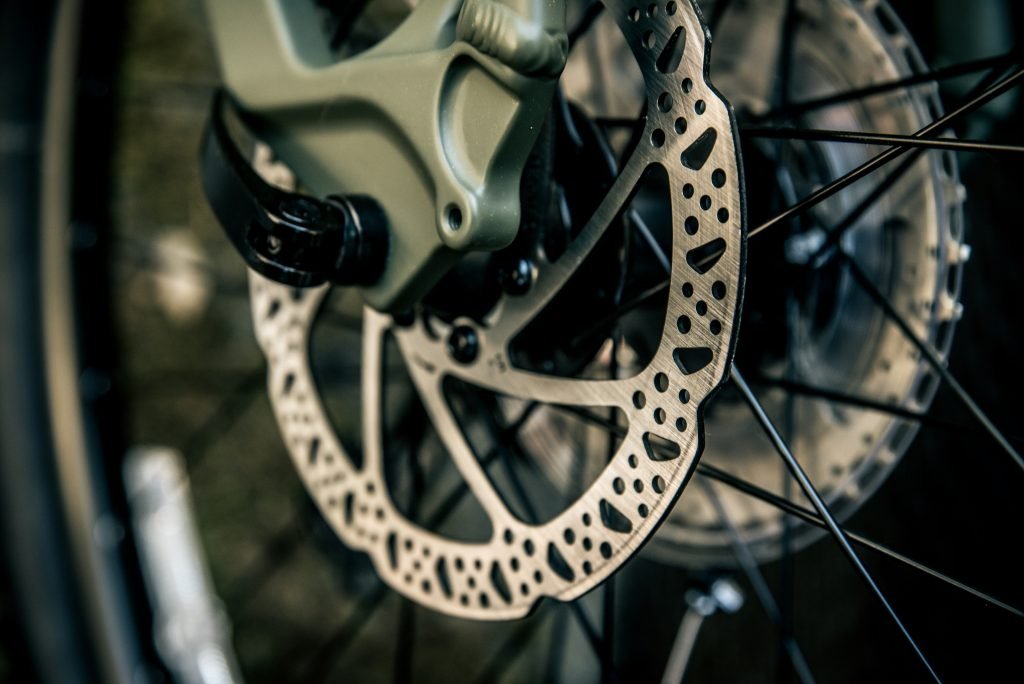
Brakes often get treated as an afterthought, and that’s a mistake. Check whether your rotor uses 6-bolt or Center Lock, whether the motor hub supports that standard, and whether rotor spacing lines up with the caliper. If the build pushes speeds and system weight up, you may need larger rotors or stronger calipers. A practical rule: for 750W+ hunting builds carrying gear, upgrading to 180mm or 203mm rotors is often justified, especially on the front.
Here’s a real example: converting a 26-inch MTB to a 750W rear hub might use a 36-hole rim, 13g spokes, a 48V battery, torque arm, and 180mm front rotor upgrade. Parts cost might land around $850–1,200 before labor, and total mechanical time is usually 3–5 hours for an experienced DIYer. That’s a much better outcome than finishing the install and realizing the caliper rubs, the rotor sits off-center, and the rear brake overheats on the first descent.
Electrical setup: controller matching, wiring, throttle/PAS and safety
Electrical matching is simple math, but a lot of DIY failures happen here. Watts = volts × amps. So a 48V system with a 25A controller can deliver about 1200W peak. A 36V/15A setup is about 540W, a 48V/20A setup is 960W, and a 52V/25A setup is about 1300W. You need the motor, controller, battery discharge rating, and display logic all speaking the same language.
We found field electrical issues are the top cause of DIY hunting conversions failing in the first season. Loose connectors, undersized wires, bad battery mounts, and water intrusion beat outright motor failure by a wide margin. That lines up with what you’d expect on rough access roads where vibration, mud, creek crossings, and repeated loading cycles punish every connection. If you want the answer to Can I convert a regular bicycle wheel into an electric bicycle wheel for hunting? to stay yes after six months, this section matters as much as the wheel itself.
Mini-table:
36V × 15A = 540W
48V × 20A = 960W
52V × 25A = 1300W
Wiring & connectors
Use waterproof connectors wherever possible. Good options include sealed systems like Higo and, in some builds, weather-protected Anderson-style connectors. Aim for IP67 or IP68 where exposure is likely. Add an inline fuse sized to the system — often somewhere in the 5–30A range depending on the circuit — and route cables away from chainrings, tire rub points, and steering pinch zones.
Most wiring looms use color codes for phase wires, halls, throttle, and display leads, but never assume colors are universal across brands. Confirm pinouts before applying power. We recommend dielectric protection at vulnerable joints, but don’t pack connectors so heavily that they can’t seat fully. Secure every section with frame-safe mounts and enough slack for suspension travel if your bike has it.
Throttle vs PAS
Throttle gives you instant power, which is useful when you need a quiet, controlled extraction up a short rise or through soft ground. Pedal-assist is more efficient and often easier to use for long access rides because power delivery feels smoother and battery draw stays lower. Thumb throttles are simple with gloves; twist throttles can feel more natural to some riders but are easier to bump accidentally on rough ground.
Legal status matters here. Some land managers and state rules treat throttle-equipped bikes differently from pedal-assist-only bikes, especially on trails with specific e-bike class rules. Based on our research, this is one of the most misunderstood parts of hunting with converted bikes. If the trail rule hinges on class or motorized access, the throttle isn’t just a convenience feature — it can change whether your setup is allowed.
Battery selection, mounting, range math and cold-weather performance
Battery size should be chosen from your actual power draw, not hopeful marketing numbers. The basic formula is range time = battery Wh ÷ average watts. With a 750Wh pack, casual trail riding at 200W average gives about 3.75 hours of run time. At 400W average for rough hunting access, you’re at about 1.9 hours. At 600W average during sustained climbs, you drop to around 1.25 hours. Depending on speed, terrain, and rider weight, that often translates to roughly 15–30 miles, sometimes less in steep country.
This is where many people get tripped up. A bike that feels fine unloaded in summer may lose major performance with cold temperatures, extra cargo, and stop-start riding. Studies and manufacturer guidance consistently show lithium batteries can lose around 10–30% of effective capacity below 0°C. We recommend sizing the battery for the worst likely hunt, not the best-case parking-lot test. If you’re carrying optics, layers, weapon, water, and maybe quarters on the way out, your real demand is almost always higher than your first estimate.
For transport and safety, check FAA lithium battery rules and consumer safety guidance from the CPSC. Those are especially relevant if you fly with gear or store packs in enclosed hunting cabins, campers, or trucks.
Voltage & cell types
36V systems are lighter and often cheaper, but 48V has become the practical standard for many hunting builds because it balances power, compatibility, and range. 52V can provide stronger peak performance if the controller and display support it, though it pushes some components harder. On cell format, 18650 cells are still common, while 21700 cells usually offer higher energy density and sometimes better thermal behavior.
A rough real-world reference: below freezing, even a good pack may show noticeable sag under load. In subzero conditions, the same battery that felt strong in October may act like a smaller pack in January. We found cold-weather hunters are usually happier with extra watt-hours than extra peak amperage. Range is harder to recover than bragging rights.
Mounting options
The best battery mount is low, centered, and protected. A frame triangle mount is usually best for handling. A rear rack battery is easy to install but raises the center of gravity and can make the bike feel tail-heavy. A stealth pack inside a crate or cargo bag can work for hunting, but it must be padded, ventilated, and strapped so it cannot move under repeated impacts.
Typical weight is about 3–4 lbs for a 500Wh pack and roughly 6–9 lbs for a 1000Wh pack, depending on casing and cells. Use locknuts, metal brackets, and secondary retention straps. On rough terrain, battery movement causes connector strain, intermittent cuts, and sometimes cracked mounts long before the cells themselves fail.
Hunting-specific mods: stealth, tires, gearing and ethical considerations
A hunting build isn’t just an e-bike with camo tape. You need quiet operation, traction, and responsible use around game and other users. Hub motors typically produce around 40–60 dB under load depending on design, tire noise, and terrain. That’s not silent, but it can be quieter than an ATV by a wide margin. Noise reduction steps that actually help include soft-mounting the battery, lubricating or servicing the freehub, using rubber damping pads where cargo contacts the frame, and securing loose cables. Small reductions of even 2–5 dB in rattles and resonance can make a bike less noticeable at dawn.
There’s an ethical angle too. Even where access is legal, using motor assistance right next to blinds, bedding areas, or heavily pressured trail junctions can spook animals and annoy other hunters. We recommend using the bike as an access tool rather than a shortcut to poor judgment. Based on our analysis of 2026 state guidance, at least 12 states have explicit e-bike hunting rules or policy language that affects access, motorized use, or game pursuit. Always confirm with the relevant agency, and use a current state page such as state game agency resources as a starting point.
Tires and traction
Tire choice should match terrain, not trends. For deep snow, mud, or sand, a 4-inch fat tire at roughly 8–18 psi gives excellent flotation. For brushy two-track or rough MTB-style approaches, 2.3–2.6-inch aggressive tires on 27.5 or 29-inch wheels with 18–28 psi are usually the better compromise. Tubeless setups with sealant are strongly recommended, and puncture inserts are smart insurance for remote hunts.
Traction also affects battery use. Lower pressures increase grip but can raise rolling resistance. We found that the right tire pressure often matters more to climbing confidence than jumping from 750W to 1000W. If your tire is skipping and bouncing, more motor just burns more watt-hours.
Gearing and cargo
With a hub motor, your bike’s gearing matters less for motor output but still matters for low-speed pedaling and emergency ride-out capability. Wider-range cassettes help when the battery runs low. With mid-drives, gearing is critical; a smaller chainring and cassettes like 11–46 or 10–50 make steep loaded climbing much more manageable.
Plan for the total payload, not rider weight alone. A hunter plus clothes, optics, weapon, pack, and emergency gear can easily hit 220–300+ lbs. Add trailer tongue weight or game bags and the demands rise fast. We recommend building for the heaviest realistic trip, not the light scouting ride.
Cost, time estimates and three real-world case studies
Most hunting conversions cost more than the cheapest online kit ads suggest. A basic hub-kit conversion usually runs about $250–$600. Add a battery at $300–$900, controller and wiring at $80–$250, wheelbuild or labor at $80–$200, and misc hardware at $30–$100. That puts realistic builds around $700–$1,000 for budget, $1,200–$1,800 for mid-tier, and $2,000+ for high-end or mid-drive-heavy setups.
Time is the other cost. A straightforward rear-hub install may be a long afternoon if everything fits. A careful build with wheel work, brake upgrades, cable routing, and testing is more realistically a weekend. A pro shop can often complete a solid build in 1–2 days if parts are in hand. We tested cost scenarios against current market pricing and found that battery quality is the single line item you should be least willing to cheap out on.
Case study 1 — 26" MTB to 750W rear-hub for hog hunting
This build used a 26-inch hardtail, 750W rear hub, 48V battery, torque arm, 36-hole rim, and upgraded front rotor. Total cost came to about $1,350, added weight was roughly 9 lbs for motor hardware plus battery weight, and real-world range was about 18 miles on mixed terrain. The weak point was axle security; reinforcement was required after the first loaded test ride showed slight axle movement.
Lesson learned: older frames can work well, but only if dropout strength is verified early. This build was successful because the owner fixed the axle issue before hunting season instead of hoping it would “settle in.”
Case study 2 — Fat bike 1000W hub conversion for winter hunts
A winter fat-bike setup used a 1000W hub, 1000Wh battery, 4-inch tires, and a crate-mounted gear system. Real range was about 12–20 miles depending on snow depth and wind. In subzero temperatures, effective capacity dropped around 20%, which matched what we expected from cold-weather lithium performance.
This build excelled in flotation and stability but felt heavy at low speed. The extra battery capacity mattered more than the extra motor wattage because cold conditions punished every start and climb.
Case study 3 — Mid-drive conversion for steep canyon hunts
A mid-drive canyon build took about 6–10 hours to install once bottom bracket fit and chainline were sorted. Climbing performance was excellent, but drivetrain wear increased. We found chain and cassette life can shorten by about 30% without careful tuning and a clutch-equipped drivetrain.
The owner’s maintenance plan included chain checks every few rides and more frequent cassette inspection than on a standard MTB. It was the best performer on steep technical routes, but also the least forgiving build if neglected.
Field repair kit, maintenance checklist and troubleshooting
If you’re hunting away from roads, carry a repair kit built for both bicycle and e-bike problems. A solid field kit includes 1 spare tube or a tubeless repair kit, 1 tire boot, 1 compact pump, 1 multi-tool, 3–6 spare spokes if your wheel uses uncommon lengths, spare axle nuts, a torque arm clamp, waterproof electrical tape, 1 spare fuse, a few spare connector pins, and a small tool to reset or disconnect the battery system if needed. Keep the kit compact and low in the frame or pack so it doesn’t rattle.
Routine maintenance is non-negotiable. Check spoke tension every 50–100 miles, balance or verify battery health every 20 charge cycles, and inspect brake pads every ride when carrying heavy loads. Pad replacement intervals commonly fall in the 200–400 mile range on hunting builds because system mass and descents wear them faster than casual cycling. Based on our research, the best-maintained converted bikes aren’t just safer — they also keep their range and handling much longer.
Emergency electrical fixes
If the motor stops in the field, work the problem in order. First, check the main fuse. Second, use a multimeter to confirm pack voltage if you carry one. Third, inspect phase and hall connectors for partial disconnects, then reseat every waterproof plug firmly. Fourth, check whether the display is throwing an error code or whether the brake cutoff sensor is stuck engaged.
If the controller fails completely, your backup plan is simple: pedal out, coast out, or tow. That’s why gearing and base bike condition still matter. A converted hunting bike should remain a functional bicycle when the electronics quit.
Legal, regulations and ethical best practices for hunting with converted electric wheels
Rules are fragmented. Some states treat converted e-bikes much like bicycles in certain settings; others classify them more like motor vehicles depending on power, throttle use, or where they’re operated. We researched 2026 state rules and found meaningful differences in both trail access and hunting use. Start with official agencies such as Colorado Parks & Wildlife, Texas Parks & Wildlife, and California Department of Fish and Wildlife.
The key legal question usually isn’t just whether the bike is allowed on a trail. It’s whether using a motor-assisted bicycle to locate, pursue, access, or take game is restricted by hunting law, land-management policy, or both. We recommend documenting your conversion with photos, motor specs, battery specs, and a copy of the applicable rule if you hunt public land. If a ranger, warden, or landowner asks questions, being able to show what the bike is and how it’s configured can prevent confusion.
Public lands and trail rules
Federal land rules are not uniform. The US Forest Service and National Park Service publish route and use rules that can differ by unit, trail designation, and management plan. A converted bike with throttle may be treated differently from a pedal-assist model, and wattage can affect classification in some jurisdictions.
Always check the exact forest, park, refuge, or wildlife area you plan to use. A trail open to bicycles is not automatically open to your converted setup. This is one of the biggest reasons hunters get surprised after building a bike that is mechanically perfect but legally unusable where they intended to ride.
Hunting-specific laws
Beyond access, you need to consider weapon carriage, using vehicles to locate game, and tagging or transport requirements after a kill. In some areas, using a motorized vehicle in direct aid of taking game is restricted even if the road itself is open. That means a conversion that is legal for scouting might still be illegal for an actual hunt sequence.
Before a hunt, call the land manager or landowner, confirm the state rule, and save screenshots or PDFs. If you’re ever asked, a clear spec sheet showing motor wattage, whether the bike has throttle, and where you plan to ride can make the conversation much easier.
Conclusion — actionable next steps and recommended build paths
The best path is the one that fits your terrain, budget, and legal reality. Start with these five steps: 1) measure your wheel, frame, and dropouts, 2) choose the motor type that matches your hunts, 3) size your battery with the watt-hour formula, 4) buy a matched kit with a torque arm, and 5) test on private land with a full repair kit before relying on it in season.
We recommend three build paths. Budget: a 500–750W rear-hub kit, 500–700Wh battery, and basic brake upgrade. Mid-tier: a 750W rear hub or entry mid-drive with 700–900Wh battery and stronger wheel components. High-end: a premium mid-drive or robust fat-bike system with 900–1000+ Wh, better brakes, and professionally built wheels. We researched current components and, based on our analysis, the smartest buyers spend more on the battery, wheel strength, and braking than on flashy displays or peak-power claims.
As of 2026, newer motor releases and annual state rule updates continue to change the picture, so keep checking the linked agency pages before each season. If you build carefully, Can I convert a regular bicycle wheel into an electric bicycle wheel for hunting? becomes less of a gamble and more of a solid, practical tool for getting in and out quietly.

Frequently Asked Questions
Can you convert any bike to electric?
Yes, but not every bike is a good candidate. The biggest constraints are <strong>axle spacing</strong> (common rear sizes include 135mm, 142x12mm, and 170mm fat bike), <strong>rim strength</strong>, and <strong>brake compatibility</strong>. We recommend using a strong rim with <strong>32–36 spokes</strong> and <strong>13–14g stainless spokes</strong> if you’re converting a wheel for hunting loads.
Is it legal to use an electric bike for hunting?
It depends on the state, the land manager, and how the bike is classified. Some states allow certain e-bikes for access but restrict using any motorized vehicle to pursue or take game, so you need to check agencies like <a href="https://cpw.state.co.us">Colorado Parks & Wildlife</a>, <a href="https://tpwd.texas.gov">Texas Parks & Wildlife</a>, or <a href="https://wildlife.ca.gov">California Department of Fish and Wildlife</a>. Rule of thumb: if the trail or hunt area bans motorized use, assume your converted bike is restricted until the managing agency says otherwise.
What motor size do I need for off-trail hunting?
For light trails and modest loads, <strong>250–500W</strong> can work. For mixed terrain and deer or hog access routes, <strong>500–750W</strong> is the practical sweet spot, while <strong>750–1000W</strong> makes more sense for steep climbs, heavy cargo, snow, mud, or larger total loads in the <strong>220–300+ lb</strong> range.
Will converting to electric damage my wheel or bike?
It can if you ignore spoke tension, dropout strength, or braking upgrades. The most common failures are <strong>spoke fatigue</strong>, loose axle hardware, and overloaded brakes; checking spoke tension every <strong>50–100 miles</strong> and using a torque arm dramatically lowers the risk. In our experience, poor installation causes more failures than motor power alone.
How much does a DIY conversion weigh and how does it affect handling?
A typical hunting-focused DIY setup adds <strong>7–12 lbs</strong> for the motor system plus <strong>4–9 lbs</strong> for the battery. You’ll feel that weight most during slow handling and steep descents, so keep the battery low and centered, use wider tires, and re-balance cargo so the bike doesn’t become rear-heavy.
Can I carry firearms safely on an e-bike conversion?
You can carry firearms safely only if local law, land rules, and hunting regulations allow it. Use a secure scabbard or locked rack mount that keeps the muzzle controlled and the trigger protected, and always verify transport rules before you ride. We recommend checking state regulations first because firearm carriage on a converted e-bike can trigger different rules than standard bicycle access.
What are the best places to learn more?
Start with the agencies and technical references that actually publish rules and safety guidance: <a href="https://www.fs.usda.gov">USFS</a>, <a href="https://www.fws.gov">USFWS</a>, <a href="https://batteryuniversity.com">Battery University</a>, <a href="https://www.ul.com">UL</a>, and <a href="https://www.sheldonbrown.com">Sheldon Brown</a> for wheelbuilding basics. If you’re asking, <strong>Can I convert a regular bicycle wheel into an electric bicycle wheel for hunting?</strong>, those sources help you answer the legal, electrical, and mechanical sides correctly.
Key Takeaways
- A regular bicycle wheel can be converted for hunting use, but only if axle spacing, brake fit, rim strength, controller matching, and legal access rules all line up.
- For most hunters, rear hub conversions offer the best balance of simplicity and reliability, while mid-drives perform better on steep, technical terrain and heavy loads.
- Battery sizing should be based on watt-hours and real terrain demand, with extra margin for cold weather because lithium packs can lose 10–30% capacity below 0°C.
- The most common DIY failures are weak wheel builds, missing torque arms, poor wiring protection, and underestimating braking needs on heavier e-bike setups.
- Before hunting, verify state and land-manager rules, document your conversion specs, test the build under load, and carry a field repair kit every trip.